Platform
Twelve modules. One governed write path
Every action in Metaware.360 takes the same route: an event, a projection, a ledger entry and a notification, committed together or not at all. That is why the record always agrees with what happened.
Know what you have
Inventory and policy
AI System Registry
Inventory with FEI classification, reliance determination, risk tier, owners, agents, tool manifests, lineage and controls.
Shadow AI discovery
Connectors for code repositories, cloud AI services, model providers and gateway traffic. Findings are matched, registered or excepted.
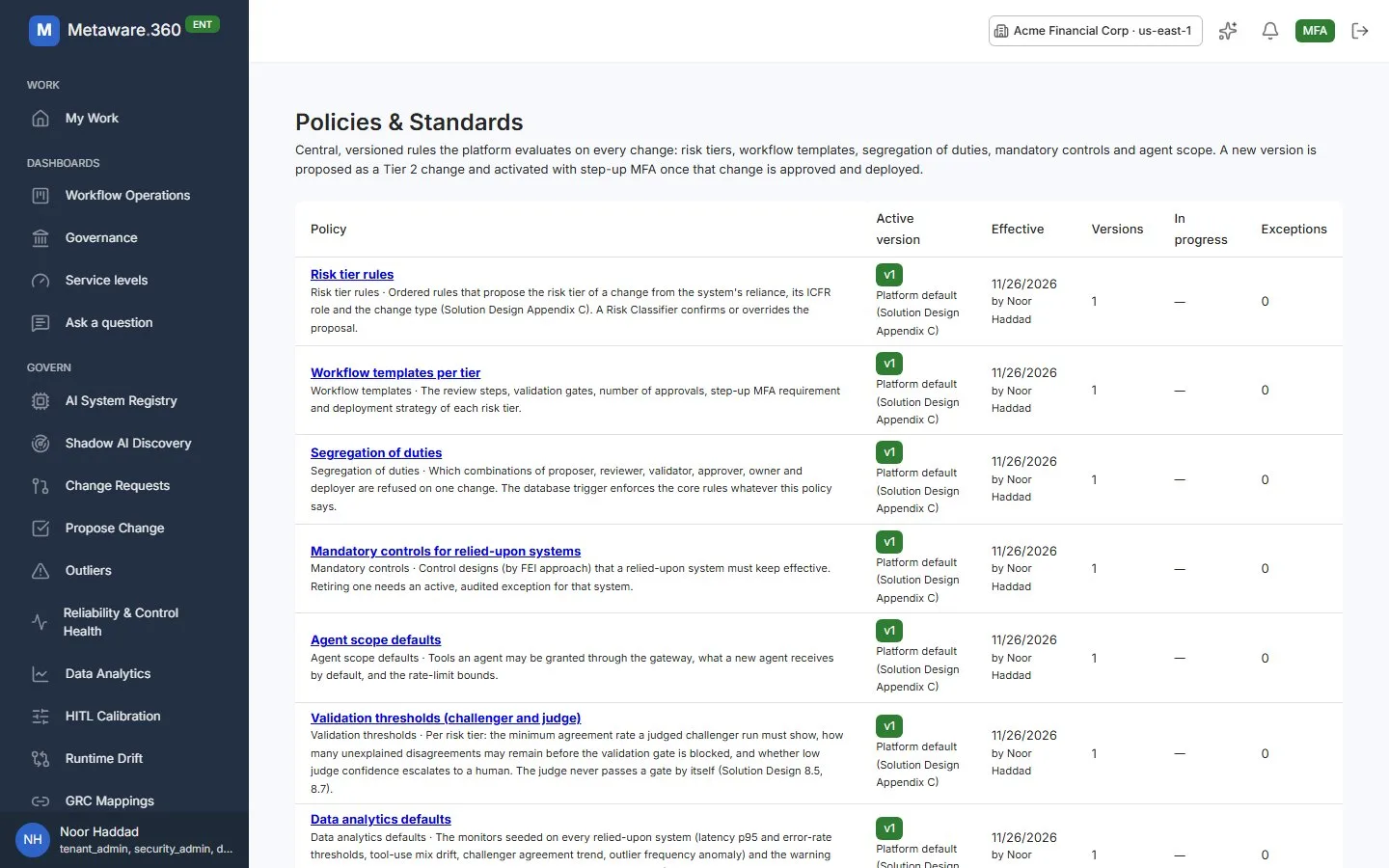
Policies and templates
Tier rules, routing and segregation of duties as versioned documents with a dry-run against history. Signed template packs for FEI, SOX and the EU AI Act.
Policy is data, not tribal knowledge
Change a tier rule and replay it against recent changes before anyone approves it. A new version is itself a governed change, activated with step-up MFA.
- Ordered rules, first match proposes the tier
- Dry-run shows what would be classified differently
- Exceptions are time-boxed and ledgered
Control the change
Workflow, review and validation
Change management
Nine change types, policy-driven tiering, artifacts bound to approvals by hash, workflow templates per tier and SLA escalation.
Human in the loop
Review tasks with attestation, approvals with segregation of duties and step-up MFA, and calibration that follows the evidence.
Validation
Versioned test sets, challenger runs and judge-model scoring. A change cannot deploy on a failed gate.
Risk and Impact Analyst
An AI-drafted assessment per change, every claim cited, confirmed by a person before it counts.
Agent Gateway
MCP and A2A endpoints so agents can propose changes and fetch approved configuration. They can never approve or deploy.
Runtime connectors
Governed deployment, read-back and drift detection for Amazon Bedrock, Azure AI Foundry, Vertex AI and LangGraph.
See where every change stands
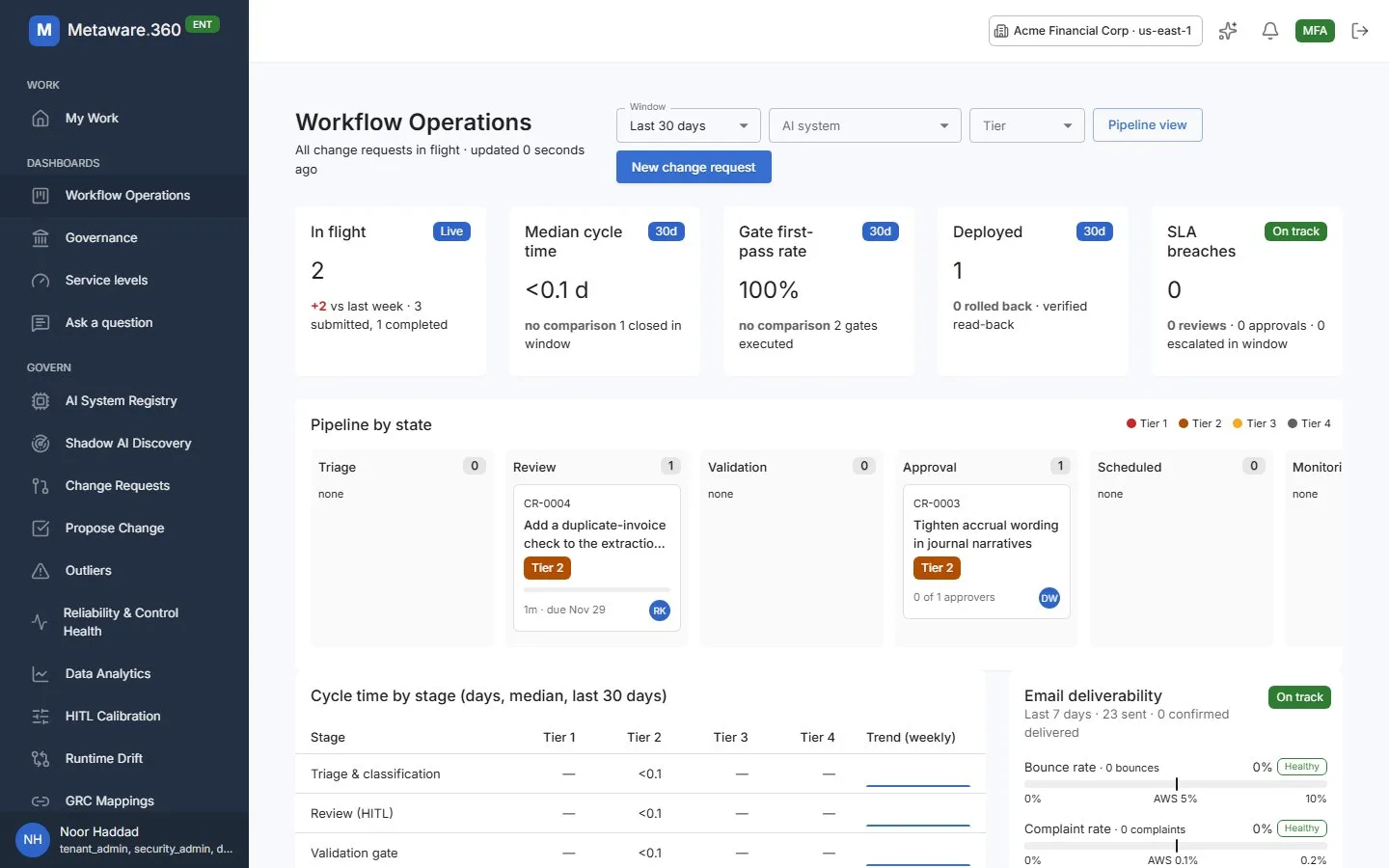
Workflow Operations shows each change in flight by stage, how long changes spend at each step and anything waiting longer than it should.
- Pipeline by state, with tier and due date on every card
- Cycle time by stage and gate first-pass rate
- SLA breaches and bottlenecks called out
Prove it
Monitoring, evidence and answers
Outliers and reliability
Intake from agents, runs and monitors. Triage with FEI factors, deficiency assessment and an explainable reliability score.
Data analytics
Population monitors and drift indicators across all agent activity. A breach on a relied-upon system raises an outlier.
Audit ledger and workspace
A hash-chained ledger with Merkle anchors and per-entry proofs. Engagements, samples, walkthroughs and custody exports.
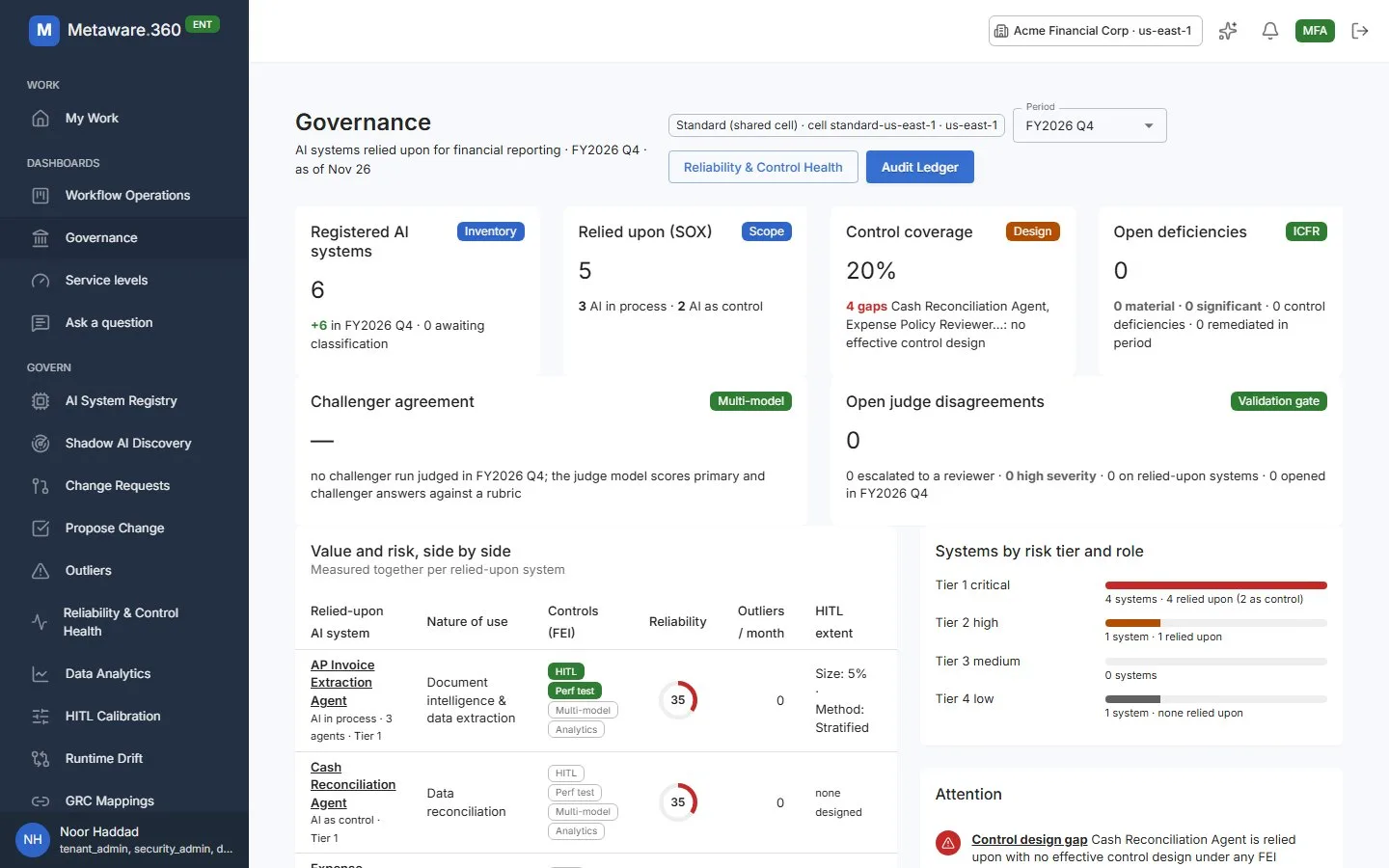
The view your audit committee reads
The Governance dashboard measures value and risk side by side for every AI system relied upon for financial reporting, per reporting period.
- Inventory, reliance and control coverage, with the gaps named
- Reliability, outliers and human-review extent per system
- Ask a question in plain language and see the query behind the answer
Integrations
Fits the stack you already run
| Category | Works with |
|---|---|
| Identity | Any SAML or OIDC provider, with mandatory multi-factor sign-in |
| Agent runtimes | Amazon Bedrock Agents and AgentCore, Azure AI Foundry, Google Vertex AI Agent Builder, LangGraph |
| Agent protocols | Model Context Protocol and Agent-to-Agent, with scoped credentials per agent |
| GRC | ServiceNow IRM, AuditBoard, Workiva |
| ITSM | ServiceNow change requests, Jira |
| SIEM | Splunk, Microsoft Sentinel, signed webhooks |
| Collaboration | Slack, Microsoft Teams, email. Approvals always stay in Metaware.360 |
Walk through the platform with us
We will follow one change from proposal to ledger proof on a demo tenant.